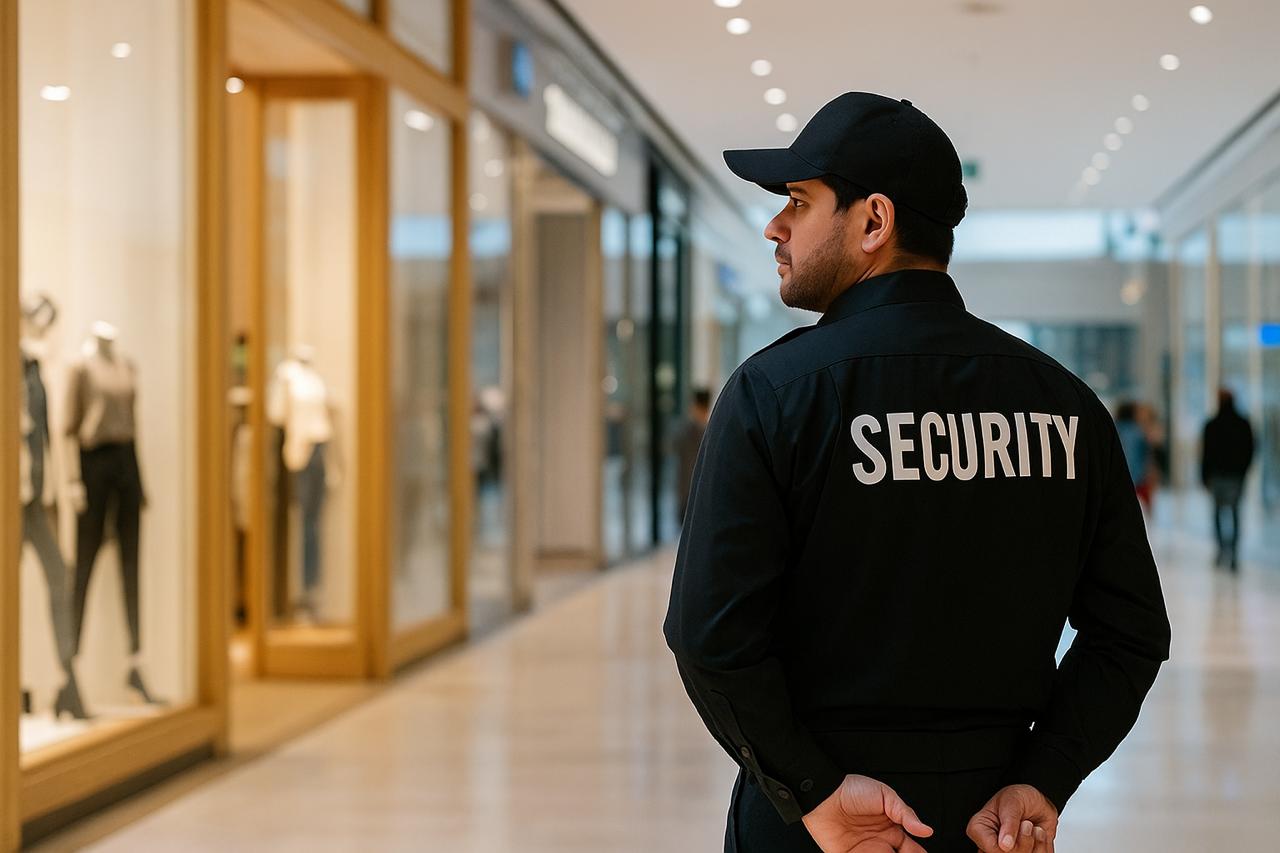
Most shopping center security failures are not failures of individual guards. They are failures of planning. A guard standing at the wrong post during the wrong hours with no clear instructions and no way to communicate with the rest of the team is not a security asset. The same guard, placed thoughtfully, briefed clearly, and integrated into a coordinated coverage plan, can prevent the incidents that drive tenants and customers away.
This guide walks through how to plan guard coverage for a shopping center from the ground up, whether you are evaluating an existing program, transitioning between providers, or designing coverage for a new property.
What Effective Guard Coverage Looks Like
A well-designed guard program for a shopping center accomplishes four things at once. It deters opportunistic crime by maintaining a visible, professional presence at the parts of the property where incidents are most likely to occur. It detects active incidents quickly enough to intervene before they escalate. It responds in a way that protects customers, tenants, and property without creating new liability. And it documents everything that happens on site in a way that supports law enforcement, insurance claims, and future planning.
A program that does only one of those things, or does them inconsistently, fails. The plan below ties all four together.
Step 1: Conduct a Site Risk Assessment
Before deciding how many guards you need or where to place them, you need a clear picture of what you are actually defending against. The threat profile of a power center anchored by big-box retailers is very different from a luxury outdoor lifestyle center, which is different again from a regional mall with a food court and movie theater.
A site risk assessment for a shopping center should identify:
- The highest-risk areas of the property. Parking lots and structures account for the majority of incidents at most shopping centers and are routinely undercovered.
- The highest-risk times of day and week. Late afternoon and evening hours, weekends, and holiday shopping periods carry elevated risk in most retail environments.
- Specific known threats. Recurring shoplifting at certain tenants, vehicle break-ins in specific lots, after-hours loitering at particular entrances, and recent incidents that suggest pattern behavior.
- Tenant and customer demographics. A center with late-night entertainment tenants has different risks than one with primarily daytime retail.
- Surrounding context. Adjacent properties, transit stops, encampments, and known crime hotspots within a few blocks of the center all shape the threat profile.
Most operators benefit from a formal security risk assessment before designing coverage. A guard plan built without that foundation tends to overinvest in low-risk areas and underinvest in the areas that actually drive losses.
Step 2: Map Coverage Zones and Posts
Once the risk profile is clear, divide the property into coverage zones and decide which zones get fixed posts, which get patrol coverage, and which get a combination.
- Main entrances and customer-facing access points. These benefit from a visible uniformed presence during operating hours, both as deterrence and as a customer-service touchpoint.
- Parking lots and structures. Usually the highest-risk area on the property. Foot patrols, bike patrols, or marked vehicle patrols are typically more effective than fixed posts here because of the large area involved.
- Anchor store entrances and tenant interfaces. Coverage requirements depend on tenant agreements and individual store risk profiles. Some tenants run their own security and want a coordination point. Others rely entirely on center-wide coverage.
- Common areas, food courts, and gathering spaces. Loitering, juvenile issues, and altercations tend to concentrate here. Regular patrol passes and a known guard presence reduce incident frequency.
- Loading docks, service corridors, and back-of-house areas. Often the source of after-hours intrusion, employee theft, and unauthorized vehicle access. Coverage here is frequently overlooked because it is not customer-facing.
- Trash and recycling areas. A common gathering point for transients and a frequent source of fire risk in retail centers.
- Perimeter and adjacent property lines. Coverage along property edges matters when adjacent properties are abandoned, transitional, or known sources of incident spillover.
Each zone gets either a fixed post, a patrol route assignment, or both. Document the zones on a site map before staffing decisions are made.
Step 3: Design Shift Coverage
The most common staffing mistake at shopping centers is treating every hour of the day as equal. They are not. The right shift design matches guard presence to actual incident frequency by hour and day of week.
Most shopping center coverage falls into three general shift bands:
Day shift (mall opening through mid-afternoon). Lower per-hour incident rates, higher emphasis on customer service, tenant coordination, and visible deterrence. Often the lightest staffing tier.
Evening shift (mid-afternoon through closing). Peak foot traffic, peak retail loss, peak parking lot activity, and frequently the highest staffing requirement.
Overnight shift (post-close through morning). Different profile entirely. Focus shifts to after-hours intrusion, vagrancy, vandalism, vehicle break-ins in unsecured lots, and tenant restocking activity. Fewer guards, but a heavy emphasis on patrol coverage and incident response.
Weekend coverage typically exceeds weekday coverage at most retail properties. Holiday shopping periods, especially November through early January, often justify temporary supplemental staffing.
Build the schedule based on historical incident data when it exists, and adjust quarterly based on what is actually happening on the property.
Step 4: Choose the Right Type of Guard for Each Post
Not every post requires the same type of guard. Mismatching the guard type to the post drives unnecessary cost or leaves coverage gaps.
- Uniformed versus plainclothes. Uniformed guards provide deterrence and customer-facing presence. Plainclothes guards, often deployed for loss prevention or surveillance of organized retail crime, work alongside uniformed coverage rather than replacing it.
- Armed versus unarmed. Most shopping center posts do not require armed coverage. Armed guards typically make sense at high-cash tenants, jewelry stores, certain late-night posts, or properties with elevated threat profiles documented through prior incidents. Armed coverage carries a higher per-hour cost and additional training, licensing, and liability considerations.
- Foot patrol versus vehicle patrol. Foot patrols are visible, approachable, and effective in pedestrian areas. Vehicle patrols cover ground faster and are essential for large parking lots and multi-building properties. Many shopping centers use both, with vehicle patrols covering perimeter and parking areas and foot patrols inside common areas.
- Bike patrol. Often underused at shopping centers. Bike patrols cover ground faster than foot but remain approachable and can navigate areas vehicles cannot. Outdoor lifestyle centers in particular benefit from bike coverage.
The right mix for a property depends on the zones identified in Step 2 and the risk profile from Step 1.
Step 5: Write Clear Post Orders
A guard without written post orders is improvising. A guard with vague post orders is improvising politely. Effective coverage requires that every guard at every post knows exactly what they are responsible for, what to watch for, how to respond to common situations, and when to escalate.
- The specific responsibilities of the post, including what to watch for, what to check, and what to document.
- Patrol routes and frequency, including timing of rounds and required checkpoints.
- Escalation procedures for incidents, including thresholds for contacting property management and local law enforcement.
- Customer service expectations. Guards at customer-facing posts represent the property and influence visitor perception.
- Documentation requirements, including daily activity reports and incident reporting standards.
- Communication protocols, including radio etiquette, check-in cadence, and how to coordinate with other guards on duty.
Post orders should be reviewed at every shift briefing and updated whenever site conditions, tenant mix, or incident patterns change.
Step 6: Integrate Technology and Communication
Guards work better when paired with the right technology. The combination of human presence and supporting systems consistently outperforms either alone.
- Camera coverage. A guard who can step into a monitoring station and review camera footage of an incident is dramatically more effective than one relying only on what they can see in person. Newer AI-enabled cameras can also flag activity for guard attention in real time.
- Radio communication. Every guard on duty should be on a single coordinated radio channel with property management and dispatch. Cell phones are not adequate for active incident coordination.
- Patrol verification systems. GPS-based patrol tracking and electronic checkpoint systems verify that patrol routes are actually being walked and document the patrol record for property owners and insurers.
- Access control integration. Guards should have visibility into who is entering tenant spaces after hours, who is using service entrances, and which alarms are active.
- Incident reporting software. Centralized digital reporting replaces inconsistent paper logs and produces the documentation that supports law enforcement, insurance, and trend analysis.
Technology does not replace guard coverage at a shopping center, but it multiplies the effectiveness of each guard on duty.
Step 7: Set the Budget and Verify the Math
Guard coverage is usually one of the largest line items in a shopping center operating budget. Setting it correctly requires basic math that operators frequently skip.
Calculate total weekly coverage hours required across all posts. A single 24-hour post requires 168 hours per week. A 16-hour daily post requires 112 hours per week. Two simultaneous 16-hour posts require 224.
Multiply total hours by the blended hourly rate, accounting for differences between unarmed, armed, supervisor, and specialty posts. Add in supervisor coverage, equipment costs, and any technology subscriptions associated with patrol or reporting systems.
Compare the total to historical loss data, tenant complaints, and incident frequency. The coverage plan is right when the cost of coverage is less than the cost of the incidents it prevents. Underinvesting saves money on the operating statement but shows up in tenant turnover, lease negotiations, customer complaints, and insurance premiums.
How Many Guards Does a Shopping Center Need?
There is no universal rule, but a few rough benchmarks help frame the question.
A typical regional shopping center of 500,000 to 1,000,000 square feet generally runs four to eight guards on duty during peak hours, scaled down for overnight and off-peak coverage.
A neighborhood shopping center of 100,000 to 300,000 square feet typically runs one to three guards during operating hours, with optional overnight patrol coverage.
A power center or community center anchored by big-box retail with significant parking acreage may require additional vehicle or bike patrol coverage regardless of total interior square footage, because the parking lot itself is the highest-risk zone.
Outdoor lifestyle centers, due to their open-air design and longer customer dwell times, often justify higher coverage than enclosed malls of similar square footage.
Final numbers should come out of the site-specific risk assessment, not generic benchmarks. The numbers above are starting points for a conversation, not specifications.
Common Mistakes to Avoid
A few patterns appear repeatedly in shopping center security programs that fail to deliver:
Treating guards as decoration. Hiring uniformed presence without integrating guards into incident response, tenant communication, and active deterrence wastes most of the value of the coverage.
Static posts only, no patrol. A guard who stands in one location for an entire shift sees only what walks past them. Patrols catch the incidents that fixed posts miss.
Skipping post orders. Coverage without written, specific instructions is inconsistent by definition. Two guards with the same job title can run wildly different posts if no one wrote down what the post is for.
Undercovering parking lots. Parking is where most shopping center incidents happen and where coverage is most often skipped. The customer who has their car broken into rarely returns.
Selecting on price alone. Guard companies are not interchangeable. The lowest bidder is frequently the lowest bidder because they pay guards less, train less, supervise less, and turn over staff faster than competitors.
No accountability mechanism. Without patrol verification, reporting standards, and supervisor oversight, even a good plan degrades quickly into a worse one.
Final Thoughts
A well-designed guard program for a shopping center is a planning exercise, not a hiring exercise. The right starting point is a site assessment, the right output is a documented coverage plan, and the right partner treats both as essential. Watchful Guard plans and operates guard coverage for shopping centers and commercial properties across California and Texas, designed around each property's actual risk profile.